

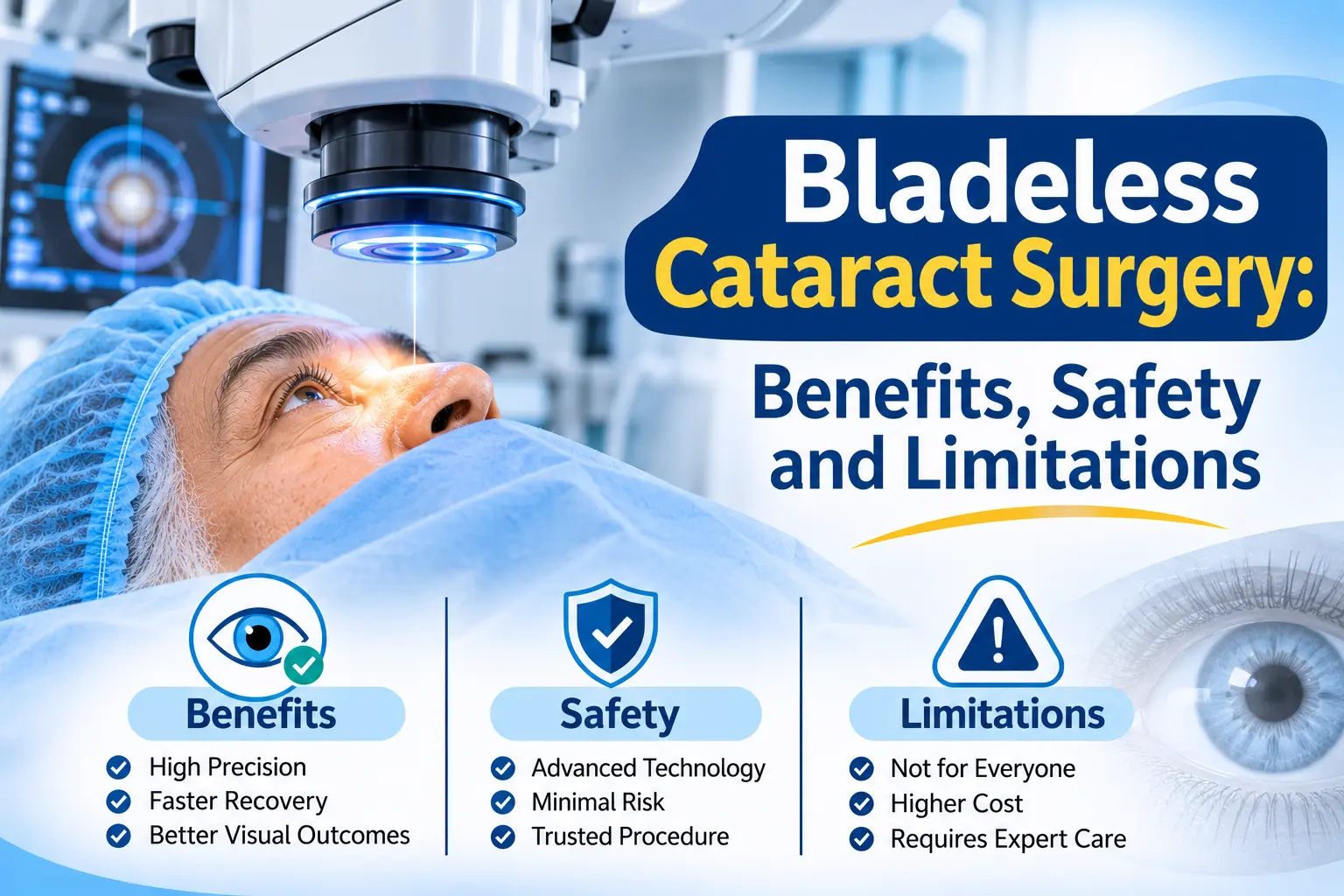
Bladeless cataract surgery is the common name for femtosecond laser-assisted cataract surgery (FLACS). Instead of a hand-held blade, a computer-guided laser makes the incisions and opens the lens capsule. One source describes it as an advanced, bladeless method that uses laser technology to make precise incisions in the eye.
The laser does not remove the cataract on its own. The surgeon still removes the cloudy lens and places the new lens. Many people call it “robotic” or “laser” surgery, but your eye doctor is in control of the whole procedure.
How Does It Work?
The process has a few clear steps:
- Eye mapping: Detailed scans measure your eye and plan where the laser should work.
- Laser incisions: The laser creates the small entry cuts and a round opening in the lens capsule.
- Lens softening: The laser can break the cloudy lens into smaller pieces, which may reduce the ultrasound energy needed.
- Lens removal: The surgeon gently removes the softened lens pieces.
- New lens: A clear artificial lens (IOL) is placed in the eye.
Most patients go home the same day, and the whole eye treatment is usually quick.
Key Benefits of Bladeless Cataract Surgery
- Precise incisions: A laser can repeat the same pattern with great consistency. This may help the new lens sit in the right position.
- Accurate lens opening: A well-centred, round opening in the lens capsule is useful, especially with premium lenses.
- Less ultrasound energy in some cases: Pre-softening the lens may mean less phaco energy is needed, which can be helpful for denser cataracts.
- Better planning for astigmatism: The laser can make special cuts to reduce mild astigmatism, so you may rely less on glasses.
- A comfortable experience: Most patients feel little or no pain, since numbing drops are used.
Is Bladeless Cataract Surgery Safe?
Yes, it is considered safe when done by a trained surgeon on a suitable patient. It is an established technique used around the world. However, safe does not mean risk-free. Like any eye surgery, it carries small risks such as infection, inflammation, swelling, or a cloudy lens capsule later on.
The laser itself has a few extra considerations:
- It needs a stable eye position and a clear view through the cornea.
- Some eyes cannot be treated well with the laser.
- Laser steps add a little time to the overall procedure.
So the technology is helpful, but it does not remove all risk.
Limitations You Should Know
- It is not always better: Standard phaco surgery already gives excellent results for most people. For routine cataracts, studies have generally found visual results to be quite similar between laser-assisted and standard methods. So the laser is not a must for everyone.
- It is not completely “blade-free” in every case: Some centres still use a small instrument for part of the procedure, and ultrasound is usually still needed to remove the lens.
- Not every eye qualifies: Very small pupils, scars on the cornea, deep-set eyes or certain other conditions can make the laser unsuitable.
- It costs more: Laser steps and the equipment raise the price, and insurers may not pay the extra amount.
- Results depend on the surgeon: A skilled surgeon with standard methods can outperform a less experienced one with advanced tools.
Cataract Surgery Cost in Lucknow
The cataract surgery cost in Lucknow depends on the technique, the lens, the hospital and the surgeon’s experience. Published figures vary a lot from one source to another, so treat any number as a rough guide:
- One Lucknow clinic guide lists standard phaco at about ₹25,000 to ₹45,000 per eye, and laser cataract surgery at ₹50,000 to ₹1,00,000 or more.
- Another price directory says laser cataract surgery in Lucknow starts from ₹42,000, with an average near ₹1,00,000 and a range that can reach ₹1,50,000.
- A comparison page notes that laser cataract surgery costs more than traditional phacoemulsification in Lucknow.
The big price differences come from lens type (monofocal, toric, multifocal or EDOF), hospital facilities, tests and follow-up visits. Always ask for a written estimate that includes the lens, medicines and check-ups.
Cataract Surgery in India: Insurance and Coverage
Cataract surgery in India is widely available, from government centres to private clinics. Standard surgery is generally treated as a medical necessity and is often covered by insurance. The laser upgrade and premium lenses may not be fully covered, so check with your insurer before booking.
Who Should Consider Bladeless Cataract Surgery?
It may be worth discussing if you:
- Want a premium lens and the most precise planning possible
- Have astigmatism that needs careful correction
- Have a dense cataract where less ultrasound energy may help
- Have a suitable eye after a full examination
If your cataract is simple and you are happy with a standard lens, regular phaco may serve you equally well.
How to Choose a Cataract Treatment Hospital
A good cataract treatment hospital matters more than any single machine. Check these points:
- Surgeon experience: Ask how many cataract surgeries your surgeon performs each year.
- Technology available: Ask which laser or phaco system the eye hospital uses.
- Hygiene: Clean operation theatres and strict sterilisation are essential.
- Transparent pricing: Get the full cost in writing.
- Follow-up care: A reliable eye care service provides clear aftercare and emergency support.
- Honest advice: A superspecialty eye hospital should explain both benefits and limits.
Care After Surgery
Good eye care after the operation protects your result:
- Use all prescribed drops on time.
- Do not rub or press your eye.
- Wear the protective shield while sleeping, as advised.
- Keep dust, smoke, water and soap away from the eye.
- Avoid heavy lifting and hard exercise for a few weeks.
- Attend every follow-up visit.
- Contact your hospital immediately if you have severe pain, sudden vision loss or heavy redness.
Important Considerations
Bladeless cataract surgery is a precise, computer-guided option that can be a good choice for some patients, especially those planning premium lenses. It is not a magic upgrade, and regular phaco remains safe and effective. Visit a trusted eye doctor, get a full check-up, ask about your options and cost, and choose what suits your eyes and budget.
FAQs –
1. What is bladeless cataract surgery?
It is laser-assisted cataract surgery where a laser makes the incisions instead of a blade. The surgeon still removes the lens and places the new one.
2. Is bladeless cataract surgery really blade-free?
The main incisions are made by laser. Some steps may still use small instruments, and ultrasound is usually needed to remove the lens.
3. Is it safer than regular cataract surgery?
Both are safe with an experienced surgeon. For routine cases, results are often similar, so safer depends on your eye and surgeon.
4. Is the procedure painful?
No, most patients feel little or no pain. Numbing drops are used, and you may feel only light pressure.
5. How long does the surgery take?
It usually takes around 15 to 30 minutes per eye. You normally go home the same day.
6. What is the cataract surgery cost in Lucknow?
Costs vary widely by technique, lens and hospital. Laser surgery generally costs more than standard phaco, so get a written estimate.
7. Does insurance cover bladeless cataract surgery?
Standard cataract surgery is usually covered. The laser upgrade and premium lens may not be, so confirm with your insurer.
8. Who is not suitable for the laser method?
People with very small pupils, corneal scars or some other eye problems may not qualify. Your eye doctor decides after an examination.
9. How long is the recovery?
Vision often improves within a day or two. Full healing takes a few weeks.
10. How do I choose the best eye hospital?
Look for an experienced surgeon, modern equipment, clean facilities, clear pricing and good follow-up care.