

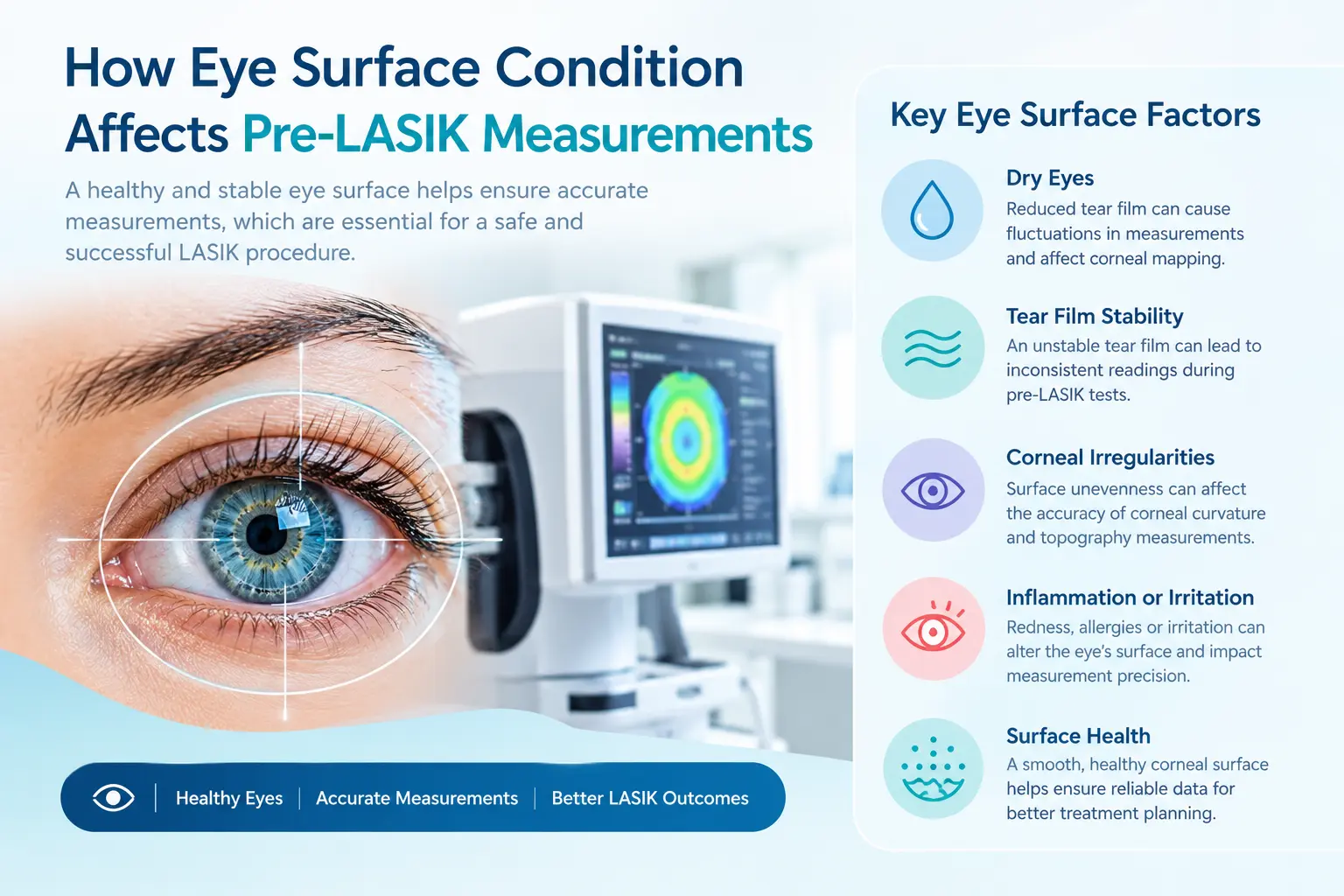
Pre-LASIK Measurements, it is essential to assess the condition of the ocular surface. Dry eye, corneal irregularities, and instability in the tear film can affect corneal measurements. Accurate measurements are crucial for planning the surgery and achieving better outcomes.
Why the Eye Surface Matters Before LASIK
Before LASIK surgery, it is essential to examine the surface of the eyes—specifically the cornea and the tear film. The condition of these structures can influence the measurements taken for the surgery and the subsequent treatment plan.
1. Tear film stability: The tear film keeps the surface of the eye smooth. If it is unstable, it can lead to discrepancies in corneal measurements and the calculated refractive power of the eye.
2. Dry eye: Dryness in the eyes can cause irritation, blurred vision, and variations in measurements. It is crucial to assess this condition prior to surgery.
3. Corneal regularity: Irregularities on the corneal surface can affect measurements of its curvature. This can complicate the process of planning the surgery.
4. Accurate assessment and improved planning: By understanding the condition of the ocular surface, a doctor can, if necessary treat any existing dryness before taking new, more accurate measurements.
5. Surgical outcomes: Precise measurements help in creating a more accurate treatment plan, which contributes to better surgical results.
- The Tear Film Is Part of the Optical Surface
Most people think of the cornea as the part of the eye that bends light, but it never works alone. A thin film of tears sits on top of it, and that film is the first surface light meets. Together, the tears and cornea provide roughly two-thirds of the eye’s focusing power. When the film is smooth, the surface behaves like polished glass. When it is patchy or breaks up quickly, the surface turns slightly uneven.
- How an Unstable Eye Surface Can Affect Measurements
LASIK planning depends on numbers: curvature, shape, thickness and the prescription itself. Those numbers come from devices that analyse reflected light, so they inherit whatever the tear film is doing at that moment. A dry or inflamed surface can nudge keratometry values, distort the corneal map and make aberrometry noisy. The result can look reasonable on paper while quietly misrepresenting the real eye, which is how an inaccurate laser plan slips through. That is why surgeons check the surface before trusting any scan.
What Happens During a LASIK Workup?
A LASIK workup is a comprehensive eye examination performed before surgery. Its purpose is to determine whether a patient’s eyes are suitable for LASIK surgery. During this process, the doctor assesses eye health, vision, and the condition of the cornea.
1. Measurement of Eye Prescription: The doctor measures the patient’s refractive error (the prescription for glasses or contact lenses) to understand the specific correction needed to improve vision.
2. Corneal Mapping: Corneal topography and tomography are used to analyze the shape, thickness, and surface of the cornea. This helps in identifying any irregularities.
3. Evaluation of the Ocular Surface: The doctor examines the tear film, checks for dry eye, and assesses the condition of the eye’s surface, as these factors can influence pre-surgical measurements.
4. Assessment of Pupils and Eye Health: The size of the pupils, intraocular pressure, and the internal structures of the eye may be evaluated.
5. Medical History and Suitability: The doctor reviews the patient’s medical history, current medications, and the stability of their vision. Based on all the findings, it is determined whether LASIK is a safe and appropriate option, or if other treatment alternatives should be considered.
- H3: Measurements Taken Before LASIK — 90 words
A proper LASIK workup is far longer than an ordinary eye test. It begins with your history, your medications and how long you have worn contact lenses. Then come distance and near vision, a manifest refraction and often a cycloplegic one, where drops relax focusing to expose hidden long-sightedness. Next are the tests that map the eye: corneal topography or tomography, keratometry, pachymetry, pupil size and sometimes wavefront aberrometry. Finally, the doctor examines the tear film, eyelids and retina and checks eye alignment, because each of these can change the surgical plan.
- Why Corneal Mapping and Thickness Measurements Matter
Corneal tomography shows the shape of both the front and back surfaces, which lets the surgeon spot early keratoconus or other weak, irregular corneas that should never be reshaped. Thickness is just as important. The surgeon needs enough tissue left under the flap once the laser has done its work, and many guidelines suggest at least 250 microns, with some surgeons preferring 300. The percentage of tissue altered also counts. Thin or unusual maps do not always rule you out, but they can steer you toward a different procedure.
Can Dry Eyes Affect LASIK Measurements?
Yes, dry eye can affect the eye measurements taken prior to LASIK surgery. The tear film on the surface of the eye keeps the cornea smooth and moist. When this layer is unstable, irregularities can develop on the corneal surface, which may lead to variations in test results.
1. Discrepancies in Corneal Measurements: An unstable tear film can cause inconsistent results in corneal topography and other diagnostic tests, which may impact surgical planning.
2. Assessment of Refractive Power: Dry eye can cause vision to fluctuate between clear and blurry, making it difficult to obtain an accurate measurement of refractive error.
3. Impact on Surgical Planning: Developing a treatment plan based on inaccurate or unstable measurements can compromise the expected visual outcome. Therefore, evaluating the ocular surface prior to surgery is essential.
4. Prior Treatment for Dry Eye: Depending on the situation, a doctor may recommend eye drops or other treatments. Once the condition of the ocular surface has improved, repeating the measurements can be beneficial.
Consequently, identifying and properly managing dry eyes before LASIK helps ensure accurate measurements and facilitates better surgical planning.
- How Tear Film Instability Can Change Corneal Readings
Yes, they can. When tears evaporate too quickly or sit unevenly, the surface your scanner sees is not the cornea’s true shape. Keratometry readings can drift between scans, topography maps may show irregular patterns that mimic disease, and the prescription itself can fluctuate from one test to the next. Contact lens wear adds to this by warping the cornea and drying the surface. Doctors often notice the problem when two readings taken minutes apart refuse to agree. A tear film that holds steady between blinks gives far more trustworthy numbers.
- When LASIK for Dry Eyes May Need to Be Delayed
Dry eye does not automatically rule out LASIK, but LASIK for dry eyes works best once the problem is under control. Surgery is usually postponed if symptoms are active, the surface shows staining, or the readings keep shifting. Dryness also tends to worsen for a few months after surgery, because the flap temporarily dulls the corneal nerves that trigger tears. Treating first lowers that risk. If dryness stays significant despite treatment, your surgeon may suggest a surface procedure such as PRK or SMILE, or may advise against laser correction altogether.
Eye Drops Before LASIK: When Are They Used?
Depending on the condition of your eyes, eye drops may be used before LASIK surgery. Their purpose is to maintain the health of the ocular surface, reduce dryness, and assist in obtaining accurate measurements during examinations.
1. For Dry Eyes: If you experience dryness or irritation, your doctor may recommend artificial tears or other appropriate eye drops. These help stabilize the tear film.
2. For Treating Infections or Inflammation: If an infection or inflammation is present, your doctor may provide the necessary treatment. In such cases, LASIK surgery may be postponed until the eyes are sufficiently healthy.
3. During Examinations: Certain eye drops are used to dilate the pupils or to facilitate the examination of the eyes.
4. In Preparation for Surgery: Doctors prescribe medications based on the patient’s eye condition and medical history.
Please note: Use any eye drops before LASIK only under the guidance of your doctor. Not every patient requires the same medications.
- Why Eye Drops May Be Recommended Before Testing
Eye drops before LASIK are not a formality. Preservative-free lubricating drops are the usual first step, used several times a day to steady the tear film and calm irritation. If inflammation or blocked eyelid glands are involved, the doctor may add a prescription drop such as cyclosporine, which can take weeks to build its effect, or a short steroid course. The aim is simple: a comfortable, stable surface on the day measurements are repeated.
- Are Laser Eye Drops the Same as Lubricating Drops?
Not quite. There is no single product called laser eye drops; the phrase usually means the drops used around laser surgery. Lubricating drops simply replace and stabilise tears. Anti-inflammatory drops such as cyclosporine treat the underlying problem, while antibiotic and steroid drops are normally prescribed after the procedure to prevent infection and control healing. Using the wrong type, or too many preserved drops, can irritate the surface, so follow your surgeon’s plan rather than choosing for yourself.
Does Corneal Thickness Change Before LASIK?
Assessing Corneal Thickness is a crucial step before LASIK surgery. The cornea is the transparent outer layer of the eye that helps transmit light to the retina. Its thickness varies from person to person and can, in certain situations, undergo changes.
1. Natural Corneal Thickness: While the thickness of the cornea generally remains stable, certain eye conditions can affect its structure.
2. Dry Eye and the Tear Film: Dryness on the ocular surface or an unstable tear film can influence measurement results, though this does not necessarily mean the actual thickness of the cornea has changed.
3. Accuracy of Assessment: Doctors measure corneal thickness using a procedure called corneal pachymetry. If necessary, the measurement can be repeated.
4. Suitability for LASIK: During LASIK surgery, a specific amount of corneal tissue is removed. Therefore, based on the cornea’s thickness and structure, the doctor determines whether LASIK is a safe option for the patient.
- What Corneal Thickness Tells the Surgeon
Normal central corneal thickness ranges from roughly 490 to 650 microns. Thickness decides how much tissue can safely be reshaped while leaving the cornea strong, so a thin cornea limits how much correction is possible, particularly for higher prescriptions. Surgeons therefore measure it more than once, often on separate visits. Small differences of a few microns between readings are normal and can reflect tear film or time of day, so repeat testing is common.
- How to Increase Cornea Thickness: What Patients Should Know
Many people search for how to increase cornea thickness, but no drop, food or supplement can thicken the cornea. What you can do is make sure the reading is accurate: treat dryness, stop contact lenses for the advised period and keep repeat appointments. If the cornea is genuinely thin, ask about alternatives. PRK avoids cutting a flap, so it preserves more tissue, and implantable contact lenses leave the cornea untouched. Cross-linking is a separate treatment for weak, ectatic corneas.
How Doctors Prepare the Eye Before Final Measurements
Accurate measurement of the eyes is essential before LASIK surgery. To achieve this, doctors first evaluate the condition of the ocular surface, the cornea, and the tear film. If issues such as dry eyes or irritation are present, they may be treated before the final measurements are taken.
1. Assessment of Dry Eyes: Doctors check for eye dryness and the stability of the tear film. If necessary, they may recommend treatments such as artificial tears.
2. Corneal Examination: The shape and thickness of the cornea are measured using techniques like corneal topography and pachymetry.
3. Stabilizing the Ocular Surface: If initial assessments yield inconsistent or unstable measurements, the doctor may first address any underlying issues affecting the ocular surface.
4. Repeat Measurements: Once the condition of the eyes has improved, the tests are repeated as needed to ensure the surgical plan is as precise as possible.
This process helps the doctor understand the state of the patient’s eyes and determine their suitability for LASIK surgery.
- Treating Ocular Surface Problems First
Preparation starts with finding out what is wrong. Dryness from low tear production is handled differently from evaporative dryness caused by blocked eyelid glands. Typical steps include warm compresses and lid hygiene, preservative-free lubricants, omega-3 supplements and, where needed, anti-inflammatory drops, punctal plugs or in-clinic gland treatments. Allergy and eyelid inflammation are treated too. Mild cases often settle within two to four weeks, while gland-related or stubborn dryness can take a couple of months.
- Why Measurements May Be Repeated After Treatment
Once the surface has improved, the key tests are done again, and they often look different. Keratometry steadies, topography becomes smoother and the refraction is easier to trust. Comparing the earlier and later results also shows whether the first set was misleading. Contact lens wearers are asked to switch to glasses first, soft lenses for about one to two weeks and rigid lenses for longer, until two readings match. Repeat testing is careful planning, not a sign that something is wrong.
When Should LASIK Measurements Be Rechecked?
It may be necessary to recheck eye measurements before LASIK surgery, especially if the results of initial examinations are not stable or if there are issues with the surface of the eyes.
1. In cases of dry eye: Dryness or an unstable tear film can affect measurements. A doctor may perform a re-examination after appropriate treatment.
2. Discrepancies in corneal measurements: If there are differences in the shape or power of the cornea across various examinations, it is beneficial to take new measurements.
3. Changes in eye condition: If examinations are affected by factors such as allergies, inflammation, or other issues, the doctor may conduct a re-evaluation.
4. Before surgery: To ensure the stability of the final measurements, the doctor may repeat the examinations as necessary.
The decision regarding the appropriate timing depends on the condition of the eyes and the advice of the specialist.
Ask your surgeon about repeating measurements in these situations:
- Persistent dry-eye symptoms: burning, grittiness or blur that clears on blinking suggests the surface has not settled.
- Unstable tear film: a short break-up time means readings may shift between scans.
- Inconsistent corneal measurements: keratometry or topography that differ between visits need an explanation.
- Recently treated ocular-surface disease: wait until improvement is stable, then retest.
- Measurements that don’t agree with the clinical examination: a map that contradicts what the doctor sees at the microscope deserves a second look.
Frequently Asked Questions
Q1. Can dry eyes change LASIK measurements?
Yes. An uneven tear film distorts the surface that scanners read, so curvature and prescription values can vary between tests. Treating the dryness first gives steadier, more reliable numbers.
Q2. Does dry eye mean I cannot have LASIK?
Not necessarily. Mild or well-controlled dryness is often manageable. If the surface stays unstable, your surgeon may delay surgery or suggest PRK or SMILE instead.
Q3. What is included in a LASIK workup?
Vision and refraction tests, corneal mapping, thickness measurement, pupil and tear film assessment, eye pressure and a dilated retina exam. Your medical history and contact lens use are reviewed as well.
Q4. Which eye drops are used before LASIK?
Usually preservative-free lubricants, sometimes with a prescription anti-inflammatory such as cyclosporine. Use only what your surgeon advises, because the choice depends on your test results.
Q5. Are laser eye drops a special product?
No. The phrase loosely covers drops used around laser surgery: lubricants before the procedure, and antibiotic and steroid drops afterwards, all as prescribed.
Q6. Can I increase my corneal thickness before LASIK?
No drop, diet or supplement thickens the cornea. You can only make sure the measurement is accurate. If it is genuinely thin, PRK or an implantable lens may be options.
Q7. What is the minimum corneal thickness for LASIK?
There is no single cut-off. Surgeons look at total thickness and the tissue that will remain after treatment, commonly at least 250 to 300 microns, along with your corneal map.
Q8. How long should I stop wearing contact lenses before measurements?
Soft lenses are usually stopped for one to two weeks and rigid lenses for three weeks or more. Your clinic will confirm the timing for your lens type.
Q9. How long does it take to treat the eye surface before LASIK?
Mild cases often settle in two to four weeks. Gland-related dryness or a cyclosporine course can take up to a couple of months.
Q10. Will dry eye get worse after LASIK?
It can for a few months while corneal nerves recover. Treating it beforehand and using lubricants afterwards usually keeps it manageable, though in some people it lingers.