

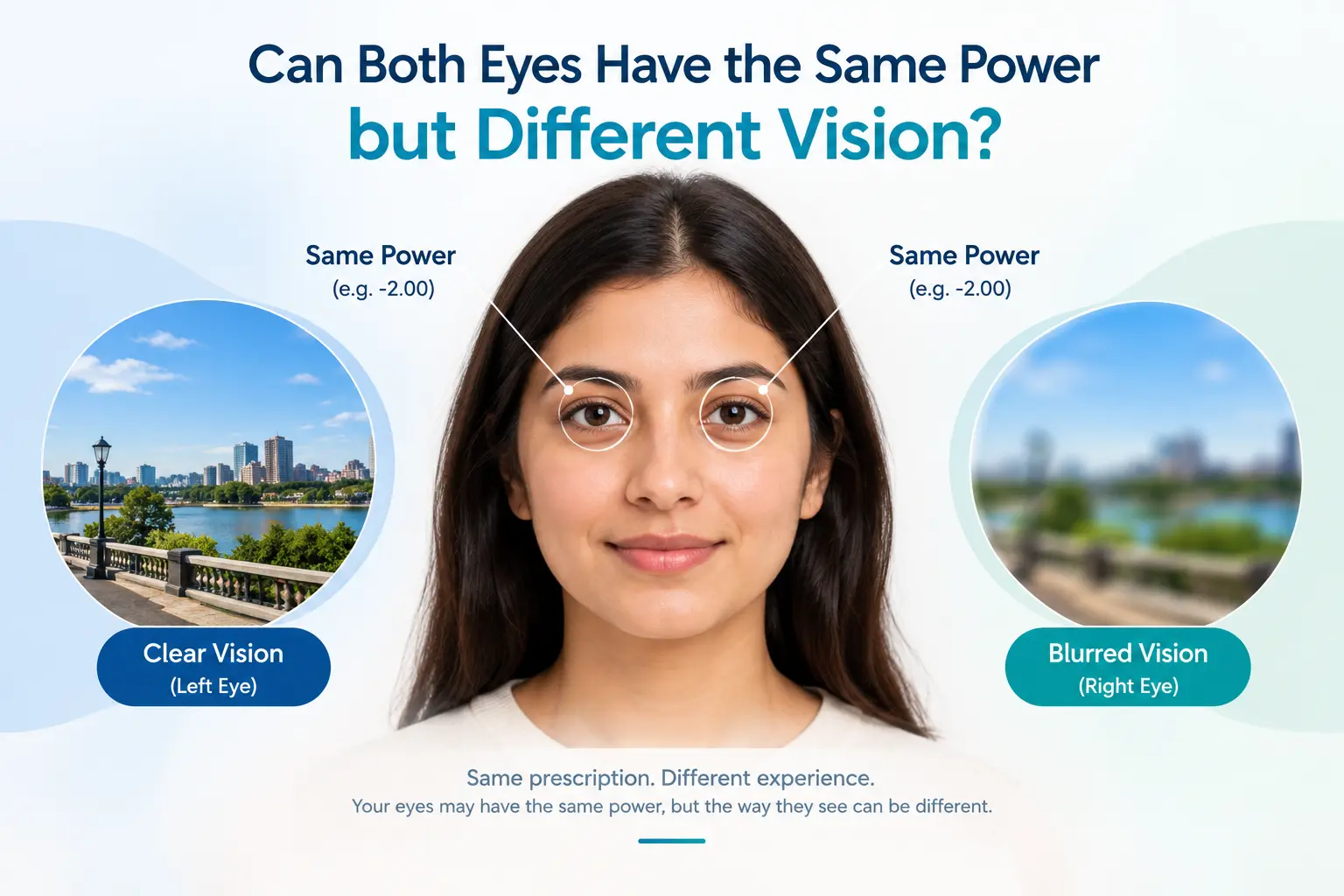
Can Both Eyes Have the Same Power but Different Vision
Yes, both eyes can have the same prescription and still produce slightly different quality of vision. An eye prescription mainly describes the refractive correction required to focus light properly on the retina. It does not describe every factor involved in how clearly an image is formed and processed.
The cornea, natural lens, retina, tear film and visual pathways can all influence vision. Small differences in these structures may make one eye appear sharper, clearer or more comfortable than the other, even when the prescription numbers are identical.
What “NORMAL EYE POWER LEFT AND RIGHT” Really Means
NORMAL EYE POWER LEFT AND RIGHT generally refers to the refractive prescription measured for each eye. If both eyes have similar spherical and cylindrical values, their prescriptions are considered similar. However, matching numbers do not guarantee identical visual performance. One eye may still have differences in corneal shape, lens clarity or retinal function.
Why ONE EYE May Still See More Clearly
ONE EYE may see more clearly despite having the same prescription as the other because visual quality depends on more than refractive power. Differences in the tear film, corneal surface, lens or retina can affect sharpness. The brain may also rely more strongly on one eye, making that eye feel naturally clearer.
What the Eye Prescription Does Not Tell You
An eye prescription is important, but it provides only part of the information needed to understand vision. Prescription numbers mainly describe refractive errors such as myopia, hyperopia and astigmatism. They do not fully describe the condition of the cornea, lens, retina or visual pathways.
This is why two people with the same prescription can report different visual experiences. Even the two eyes of one person may perform differently despite having similar refractive measurements. Visual clarity depends on how accurately light enters the eye, how the optical structures transmit it and how the retina and brain process the resulting image.
Cornea, Retina and Lens Can Change Image Quality
The cornea is the eye’s main focusing surface, so irregularities in its shape or surface can affect image quality. The natural lens also influences clarity, and changes in its transparency can make vision hazy or reduce contrast. The retina converts light into signals for the brain, so differences in retinal function can also affect how clearly an eye sees.
Why Sharpness Is Not Determined by Power Alone
Eye power primarily describes how light is focused relative to the retina. It does not measure contrast sensitivity, corneal irregularities, higher-order optical effects, retinal health or tear-film stability. These factors can influence perceived sharpness even when the prescription is accurate. Therefore, BOTH EYES can have matching prescription numbers while producing slightly different visual experiences.
When One Eye Has a Different Refractive Error
Sometimes the difference between the eyes is directly related to their refractive prescription. One eye may be more nearsighted, farsighted or astigmatic than the other. This condition is commonly called anisometropia.
The degree of difference matters. Small differences may cause few noticeable symptoms, while larger differences can make the images reaching the brain significantly different in clarity or size. Some people adapt easily, while others may experience eye strain, headaches or difficulty adjusting to glasses. A detailed eye examination helps determine the nature and significance of the difference.
Anisometropia Definition and Anisometropia Meaning
The ANISOMETROPIA DEFINITION is a condition in which the two eyes have different refractive powers. In simple terms, the ANISOMETROPIA MEANING is that each eye requires a different optical correction.
The difference may involve myopia, hyperopia or astigmatism. Depending on its severity, anisometropia can affect how comfortably the eyes work together. Some people have no obvious symptoms, while others notice unequal clarity, eye strain or difficulty adapting to corrective lenses.
Myopia in One Eye and Astigmatism in One Eye
MYOPIA IN ONE EYE is possible when one eye is nearsighted while the other has little or no myopia. Similarly, ASTIGMATISM IN ONE EYE can occur when only one eye has an irregular optical curvature.
These differences may sometimes go unnoticed because the stronger eye compensates for the weaker one. However, an eye examination can identify unequal refractive errors and determine whether the difference is purely optical or associated with another eye condition.
Why One Eye May Look or Feel Different
Not every difference between the eyes is caused by prescription. People may notice differences in appearance, brightness, comfort or clarity. Some are normal anatomical variations, while others can be associated with an eye condition.
The important factor is whether the difference is longstanding or has appeared recently. A sudden change should not automatically be blamed on glasses power. If a person notices a new difference between the eyes, especially with pain or reduced vision, an eye examination can help identify the cause.
WHY IS ONE EYE SMALLER THAN THE OTHER?
WHY IS ONE EYE SMALLER THAN THE OTHER can refer to differences in eyelid position or the visible opening of the eye rather than the actual size of the eyeball. Facial anatomy, eyelid position, swelling or previous injury can make one eye appear smaller.
Mild asymmetry may simply be natural. However, if the appearance changes suddenly or is accompanied by drooping, swelling, pain or vision changes, medical evaluation is advisable.
WHY ONE EYE SEES DARKER THAN THE OTHER
If ONE EYE SEES DARKER THAN THE OTHER, several factors may be involved. Differences in the cornea or natural lens can affect how much light reaches the retina. Retinal function and the visual pathway can also influence perceived brightness.
A mild difference that has remained unchanged may have a longstanding explanation. However, a new or worsening difference deserves attention. Sudden changes accompanied by flashes, floaters, pain or vision loss require prompt assessment.
Can ONE-EYE GLASSES Fix Unequal Vision?
When the eyes require different refractive corrections, glasses can be prescribed with different powers for each eye. The purpose is to provide the clearest and most comfortable vision possible rather than making both lenses identical.
The term ONE-EYE GLASSES may be used when only one eye requires significant correction. In practice, both lenses can be made according to the individual prescription, with one lens potentially having little or no power.
When Different Lenses Are Prescribed for Each Eye
Different lens powers for each eye are common when the eyes have unequal prescriptions. One eye may require stronger correction for myopia, hyperopia or astigmatism.
The doctor determines each lens power separately based on the examination. The goal is to achieve good clarity while ensuring that the two eyes work together as comfortably as possible.
When Glasses Are Not the Whole Solution
Glasses correct refractive errors but cannot treat every cause of unequal vision. If one eye remains significantly weaker despite an accurate prescription, the doctor may examine the cornea, lens, retina or optic nerve.
Persistent differences should therefore not automatically be attributed to glasses power. Further testing may be needed to understand whether the cause is optical, structural or neurological.
Anisometropia Treatment and When an Eye Examination Matters
The appropriate ANISOMETROPIA TREATMENT depends on the difference between the eyes, symptoms, age and overall eye health. Some people can be managed successfully with glasses, while others may benefit from contact lenses.
Children need particular attention because unequal visual input during development can contribute to amblyopia. Adults with significant differences may also need careful correction to ensure comfortable binocular vision.
How ANISOMETROPIA TREATMENT Is Selected
The first step in ANISOMETROPIA TREATMENT is identifying the exact refractive difference through a comprehensive eye examination.
Glasses may work well when the difference is small and comfortable. Contact lenses can sometimes reduce differences in image size between the eyes and may be considered when glasses cause difficulty.
The appropriate option depends on the individual’s prescription, symptoms, age and eye health. Treatment should therefore be selected after examining each eye rather than simply trying to make both prescriptions identical.
What Your Two Eyes Should Ideally Tell Your Eye Doctor
Consider booking a consultation at Chandra Super Speciality Eye Hospital in Lucknow if you experience persistent watering or dryness, a sagging or outward-turning lower eyelid, visible white below the iris, or Your two eyes do not need to produce perfectly identical images to be healthy. What matters is whether differences are longstanding, stable and explained by the eye examination. Our specialists can help you understand the available options for oculoplastic treatment in Lucknow and determine whether surgery may be appropriate for your needs. Early consultation with a qualified oculoplastic specialist can help you make an informed decision about your eye health and treatment options.
Tell your eye doctor if ONE EYE consistently sees less clearly, appears darker, feels different or requires a substantially different prescription from the other eye. Also mention sudden changes, pain, flashes, new floaters, double vision or loss of vision. These details can help determine whether additional testing is necessary.
Frequently Asked Questions
1. Can both eyes have the same power but different vision?
Yes. Matching prescriptions do not guarantee identical visual quality. Differences in the cornea, lens, retina, tear film or visual processing can make one eye see more clearly.
2. Why do my eyes see differently even when they have the same prescription?
Prescription numbers measure refractive correction, but they do not describe every factor affecting vision. Corneal shape, lens clarity, retinal health and tear-film quality can influence visual sharpness.
3. What is anisometropia and what does anisometropia mean?
Anisometropia means that the two eyes have different refractive powers. One eye may be more myopic, hyperopic or astigmatic than the other.
4. Can you have astigmatism in only one eye?
Yes. ASTIGMATISM IN ONE EYE is possible. One eye may have astigmatism while the other has little or none.
5. Can you have myopia in one eye and normal vision in the other?
Yes. MYOPIA IN ONE EYE can occur when one eye is nearsighted while the other has little or no refractive error.
6. Why does one eye see darker than the other?
If ONE EYE SEES DARKER THAN THE OTHER, differences in the cornea, lens, retina or visual pathway may be involved. A new or sudden change should be evaluated.
7. Why is one eye smaller than the other?
The appearance may be related to eyelid position, facial anatomy or surrounding tissues rather than actual eyeball size. A sudden change should be examined.
8. Can one eye need glasses while the other eye does not?
Yes. One eye may have a refractive error while the other requires little or no correction. Each lens can therefore have a different prescription.
9. What is the treatment for anisometropia?
ANISOMETROPIA TREATMENT depends on the degree of difference and the individual’s needs. Glasses or contact lenses may be used depending on the situation.
10. When should I see an eye doctor if one eye sees differently?
Arrange an eye examination if the difference is new, worsening or persistent, especially with pain, flashes, floaters, double vision or reduced vision. Sudden vision changes require prompt medical attention.